
Key Summary
- Best Use Case: Mid-to-large enterprises with JavaScript-heavy websites, dedicated technical SEO teams, and budgets to match — particularly brands that need to solve AI crawler accessibility issues at the infrastructure level.
- Pricing Snapshot: Starts at $100/month (Explorer), but the plan most businesses actually need runs $500/month (Growth). Agency plans start at $500/month. Annual agreements unlock roughly a 17% discount.
- Standout Feature: The Agent Experience Platform (AXP), a middleware layer that intercepts AI bot requests at the CDN edge and delivers a pre-rendered, AI-optimized version of your site. There’s nothing else quite like it on the market.
- Main Limitation: The AXP is a “black box” that carries real SEO risk (think: cloaking), and there’s limited independent evidence that it moves the needle. For most agencies and SMBs, the price-to-value ratio just doesn’t add up.
- Bottom Line: Impressive engineering, but not built for most marketing teams. A specialized tool for a specialized problem.
Introduction: The Question Every Client Is Asking in 2026
Picture this: You’re sitting in a strategy call with a client — a regional HVAC company that ranks in the top three on Google for every keyword that matters to their business. Traffic is solid. Leads are coming in. Then they ask a question that stops you cold:
“My nephew told me he asked ChatGPT for HVAC recommendations and we didn’t come up. Why?”
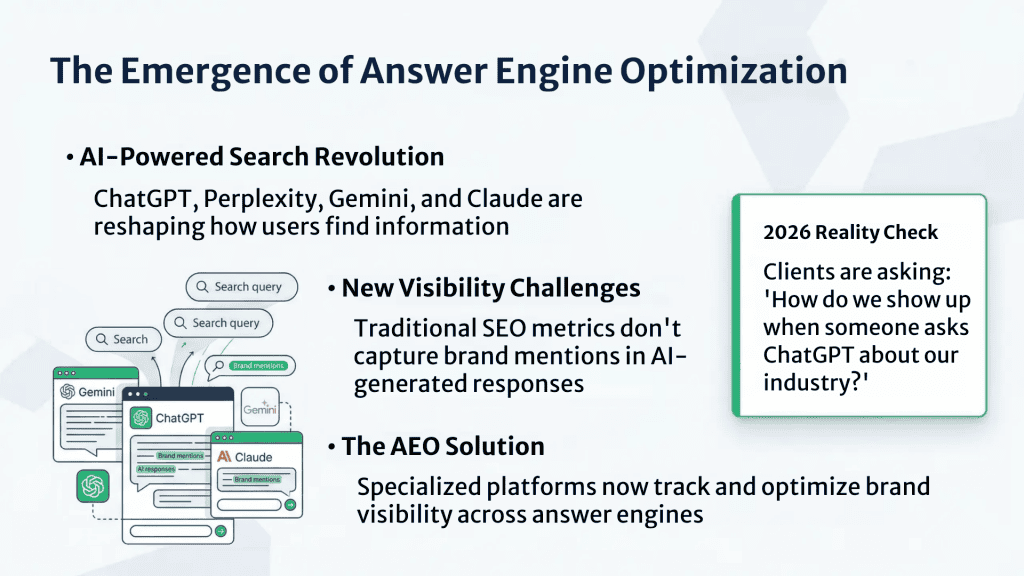
That question is happening in boardrooms and agency calls across the country right now, and it’s exactly the pain point that a growing category of tools called AEO platforms — Answer Engine Optimization software — was built to address. These tools track your brand’s visibility across AI-powered engines like ChatGPT, Perplexity, Gemini, and Claude, helping you understand not just if you’re being mentioned, but why, where, and how to improve.
I’ve spent the better part of the last two years evaluating over a dozen tools in this space for my agency. After all that testing, I currently use Cairrot as my daily driver for client AEO work because it gives me clear, actionable outputs at a price that doesn’t require a dedicated budget line per client. But I keep a close eye on the competition, and Scrunch AI is consistently one of the most talked-about platforms in this category.
My verdict on Scrunch after hands-on testing: it’s genuinely impressive technology that solves a very real problem — just not the problem most marketers actually have.
Core Review: What Does Scrunch AI Actually Do?
Scrunch AI, founded in 2023 and officially out of beta as of March 2025, is built around three core pillars: monitoring your AI visibility, generating insights from that data, and solving technical accessibility issues through its Agent Experience Platform (AXP). The company has raised $19 million in funding to date — a $4M seed round in March 2025 and a $15M Series A in July 2025 — and that investment shows in the product.
AI Visibility Monitoring: The Dashboard You’ll Live In
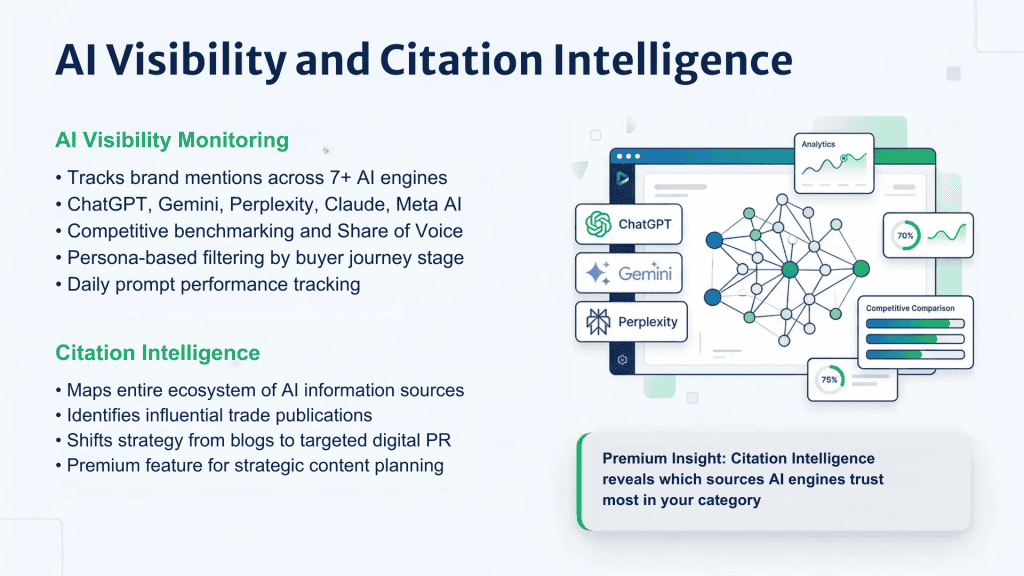
The heart of Scrunch is its monitoring suite. It tracks brand mentions and citations across 7+ LLMs including ChatGPT, Gemini, Perplexity, Claude, and Meta AI. This is solid coverage, though it’s worth noting their Starter plan focuses primarily on ChatGPT, with broader coverage available on higher tiers.
What separates Scrunch’s monitoring from basic trackers is the depth of segmentation:
- Competitive Benchmarking: Track your Share of Voice against named competitors across specific prompts, measuring both presence (were you mentioned?) and position (were you first or fifth in a list of recommendations?).
- Persona-Based Filtering: Segment visibility data by buyer persona, funnel stage, and geographic market. This is genuinely useful for enterprise brands with complex customer journeys — it tells you if you’re reaching the CFO or just the intern doing initial research.
- Prompt-Level Forensics: Drill down to a single prompt and track its performance day-by-day — sentiment shifts, citation changes, position movement. This is your diagnostic tool when a content update causes unexpected volatility.
For a national brand managing multiple campaigns, this level of granularity is valuable. For a local plumber or a regional accounting firm? It’s probably more data than you need.
Citation Intelligence: Mapping the AI Information Supply Chain
This is where Scrunch starts to earn its premium price tag for the right buyer. The Citation Intelligence module doesn’t just show you that certain sources are being cited — it maps the entire ecosystem of sources feeding AI answers in your category.
In practice, this means you can see if 70% of AI citations for a key industry topic flow through three specific trade publications or analyst sites. Once you know that, your content strategy shifts from “publish more on our blog” to “get mentioned on those three platforms.” It turns a vague content mandate into a specific digital PR target list.
The limitation here — and it’s notable — is that the actionability stops at the data. Scrunch identifies the opportunity; it doesn’t help you execute on it. There’s no content editor, no brief builder, no AI writing assistant baked in. You take the insight and run with it yourself. For a lean team or a solo marketer, that gap matters.
AI Bot Traffic & Site Audits: The Technical Layer
Scrunch integrates directly with Google Analytics 4 to pull and visualize AI bot traffic data — crawl activity from GPTBot, ClaudeBot, Perplexity-Bot, and so on. This is data that technically exists in GA4 already, but Scrunch surfaces it in a clean, presentation-ready format that saves significant time when building client reports.
The platform also includes a Page Audit tool that scores individual pages on “AI-friendliness” — flagging issues that could prevent crawlers from indexing your content properly. Thin content, poor schema implementation, JavaScript rendering problems — these all surface in the audit.
Fair warning: many of the issues it flags require developer-level fixes. If you don’t have a dev on call, you may find yourself staring at a long list of problems with no clear path to fixing them yourself.
The Agent Experience Platform (AXP): Scrunch’s Biggest Bet

Here’s where things get genuinely interesting — and genuinely controversial.
The AXP is a middleware layer that sits at your CDN edge (integrating with Cloudflare, Vercel, and similar providers). When it detects an AI crawler hitting your site, it intercepts that request and serves a simplified, pre-rendered, AI-optimized version of your page instead of the standard user-facing version. The goal is to solve the problem of AI bots failing to render JavaScript-heavy pages.
On paper, this is an elegant solution. A full site rebuild to solve a rendering problem could cost a company hundreds of thousands of dollars and take years. The AXP is a shortcut. For enterprise brands running complex Single Page Applications (SPAs) built in React or Vue.js — where AI bots are effectively getting a blank page — this is a compelling proposition.
The risk, however, is real. Serving different content to bots than to users is the definition of cloaking — a practice that Google has penalized for over two decades. While AI search engines are uncharted territory, building your strategy on a tactic that violates the spirit of long-established webmaster guidelines is a significant gamble. There’s also limited independent evidence that AXP actually improves citation rates; the supporting data largely comes from Scrunch’s own case studies.
I spent a few days trying to find third-party validation of AXP results. I couldn’t. That’s not a reason to dismiss it outright — the category is new — but it is a reason to proceed cautiously.
Scrunch AI Pricing & Plans
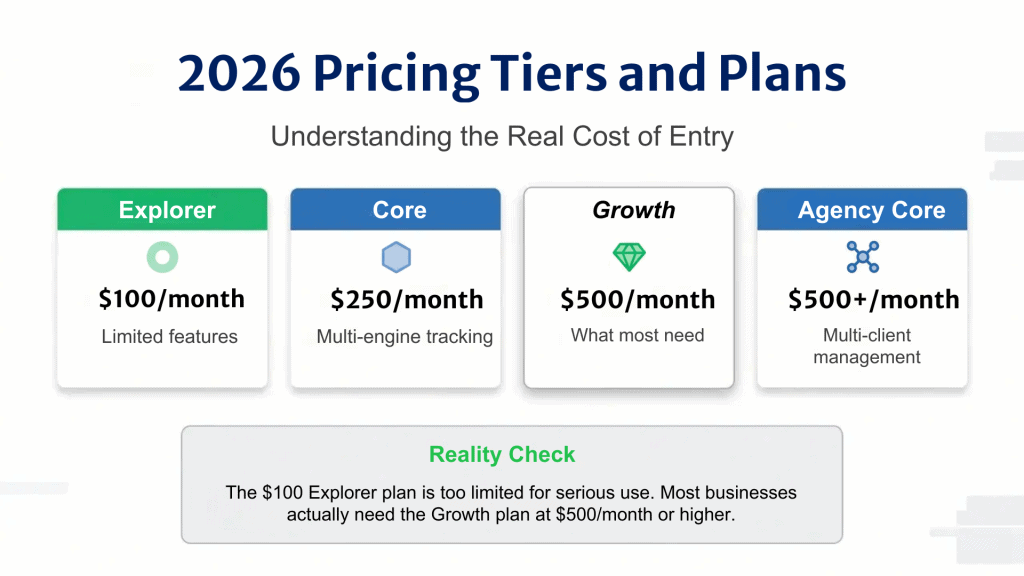
Scrunch’s pricing structure changed in early 2026. Based on current information from their pricing page and verified user data on G2, here’s how it currently breaks down:
Scrunch AI Pricing Tiers (2026)
| Plan | Monthly Cost | Annual Cost | Key Features | Prompt Limits | Users |
| Explorer | $100/mo | ~$83/mo (17% off) | Basic monitoring, ChatGPT focus | Limited | 1 |
| Core | $250/mo | ~$208/mo | Multi-engine tracking, Citation data, Persona segmentation | ~350 custom prompts | 3-5 |
| Growth | $500/mo | ~$415/mo | Advanced segmentation, Deeper insights, GA4 integration | ~700 prompts | 5+ |
| Agency Core | $500/mo | Custom | Multi-client management, Pitch environments | Per brand | Multiple |
| Enterprise | Custom | Custom (2 months free) | AXP access, API, SOC 2, Dedicated support | Unlimited | Unlimited |
A few things worth calling out here:
The effective entry price is higher than it looks. The $100 Explorer plan is too limited for agency or serious brand work. The plan most business users actually need — Growth or Agency Core — starts at $500/month. That’s before adding user licenses ($25/month for one additional seat, $75/month for up to five additional seats).
The AXP is enterprise-only. If the Agent Experience Platform is the feature that attracted you to Scrunch, you’ll need to contact sales for custom enterprise pricing. There’s no self-serve path to that feature.
Annual discounts are meaningful. Annual commitments get the equivalent of two months free — roughly 17% — which is worth factoring in if you’re committed to the platform.
User Experience & Interface
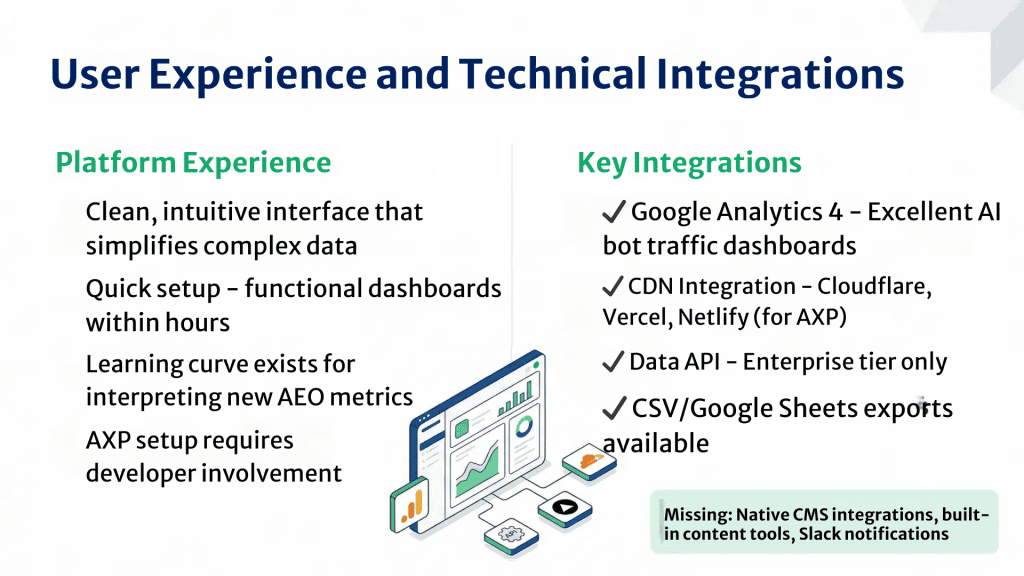
Credit where it’s due: Scrunch has built a clean, intuitive interface for a platform that does technically complex things. Setup is straightforward — most users report getting a functional dashboard running within a few hours. Reviews on G2 consistently note that the UI is one of the platform’s stronger points.
That said, the simplicity of the front end can create a false sense of clarity. The platform shows you a lot of data, but it’s not always obvious what to do with it. There’s no hand-holding through the “so what now?” phase after you’ve identified that your brand has low visibility for a key prompt. You need to bring your own expertise.
It took me about three days of regular use before I felt like I was getting genuine value from the dashboard rather than just exploring it. That’s not a terrible learning curve, but it’s real. One G2 reviewer put it well: “This isn’t Google Analytics. You’ll need to invest time understanding the new metrics.” The onboarding team at Scrunch is, by most accounts, responsive and helpful during this phase.
The AXP setup is another level of complexity entirely. Integrating it with a CDN requires developer involvement. This isn’t a point-and-click configuration.
Integrations & Compatibility
Scrunch’s integration story reflects its enterprise focus:
- Google Analytics 4 — The strongest integration. AI bot and referral traffic dashboards are genuinely excellent and save meaningful time in client reporting.
- CDN Integrations (Cloudflare, Vercel, Netlify) — Required for the AXP feature. If your site runs on a compatible CDN, setup is manageable. If not, the AXP isn’t available to you.
- Data API — A significant feature for technical teams wanting to pipe data into HubSpot, Salesforce, Looker, or Tableau. The catch: API access is gated behind Enterprise plans. For agencies building custom reporting dashboards, this is a meaningful barrier.
- CSV/Google Sheets Exports — Available on standard plans for basic data portability.
- Platform Coverage — Web-based, no dedicated desktop or mobile app. Works well on modern browsers.
Notable missing integrations: No native CMS integrations (WordPress, Webflow, HubSpot CMS), no built-in content editor or AI writing tools, and no dedicated Slack or project management integrations for team notifications.
Customer Support & Resources
Scrunch’s support offering scales with your plan:
- Self-Serve Plans: Email support with standard response times. Documentation and a knowledge base are available. Quality of written documentation is generally solid.
- Agency Plans: More direct access to support, including onboarding assistance and an agency partner program with training resources and referral incentives.
- Enterprise Plans: Dedicated customer success management and white-glove onboarding.
The general consensus from user reviews is that the support team is knowledgeable and genuinely engaged with questions, particularly during onboarding. I’d describe their documentation as functional rather than exceptional — adequate to get you running, but light on advanced strategy guidance.
There’s no public community forum or user group, which is a gap for a tool at this price point. Competitors like Semrush (with years of community infrastructure) have a distinct edge here.
Pros & Cons of Scrunch AI
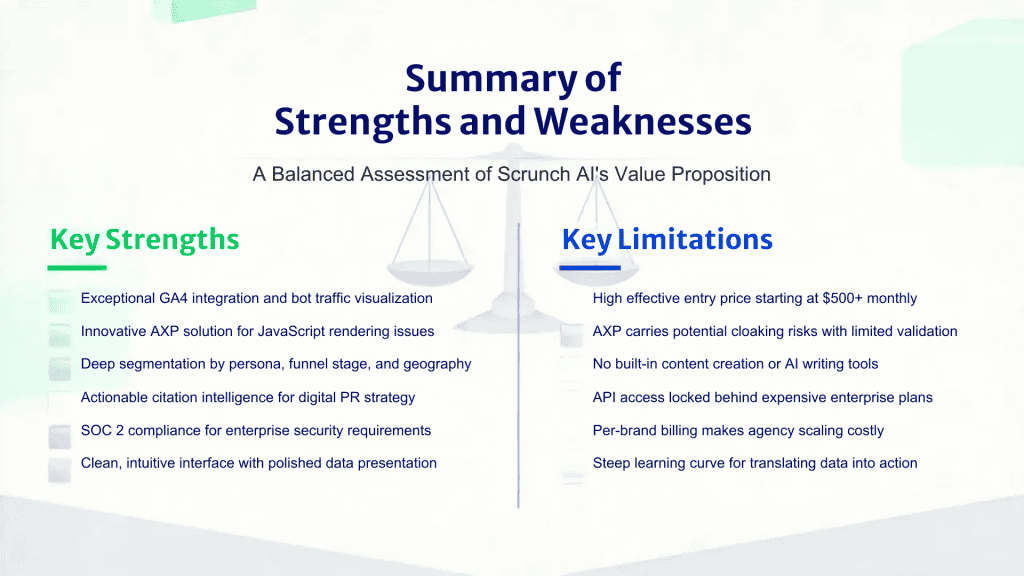
Table: Scrunch AI Strengths and Weaknesses
| Pros | Cons |
| Exceptional GA4 integration for AI bot traffic visualization | AXP carries real cloaking risk with limited independent proof of effectiveness |
| Deep persona and funnel-stage segmentation for enterprise use cases | Steep price jump from Explorer ($100) to the plans that actually deliver value ($500+) |
| Citation Intelligence provides an actionable digital PR targeting map | API access locked behind enterprise plans — a blocker for agencies building dashboards |
| AXP is a genuinely novel solution to JavaScript rendering problems for AI bots | Monitoring-only; no built-in content creation, brief builder, or optimization workflow |
| SOC 2 Type II compliance makes it viable for enterprise procurement processes | Learning curve is real; data-rich but not prescriptive in guiding next steps |
| Tracks 7+ LLMs including ChatGPT, Gemini, Perplexity, Claude, and Meta AI | Pricing per brand means multi-brand agencies face rapid cost escalation |
| Free trial available for initial evaluation | AXP requires developer resources to implement — not self-serve |
Head-to-Head: Scrunch AI vs. Top Competitors
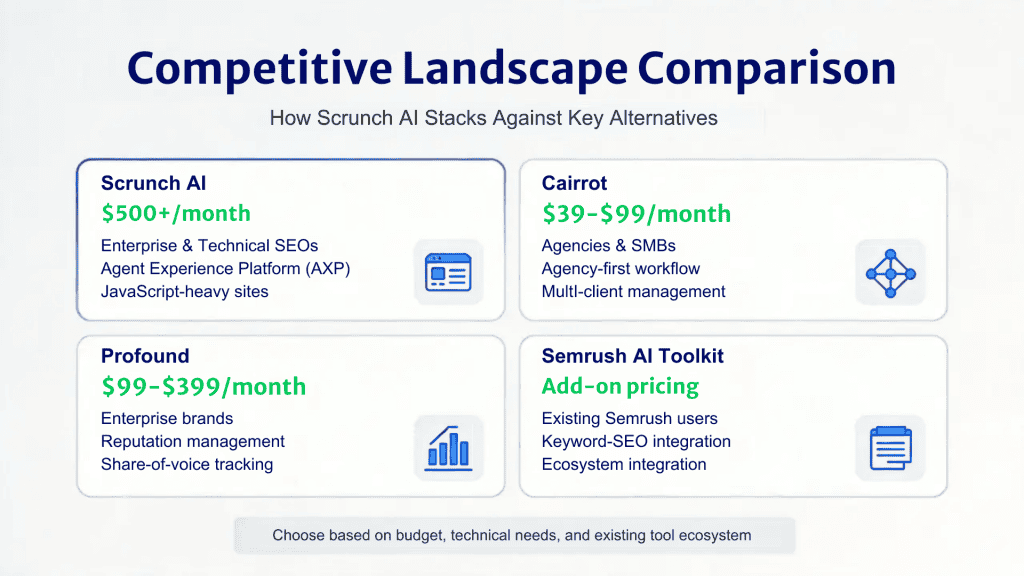
Table: Scrunch AI vs. Cairrot vs. Profound vs. Semrush AI Visibility Toolkit
| Factor | Scrunch AI | Cairrot | Profound | Semrush AI Toolkit |
| Monthly Starting Price | $100 (Explorer) / $500 (useful tier) | ~$39–$99 | $99 (Starter) / $399 (Growth) | Add-on to Semrush subscription |
| Primary Target User | Enterprise brands, technical SEOs | Marketing agencies, SMBs | Enterprise brands, comms teams | Existing Semrush users |
| LLMs Tracked | 7+ (ChatGPT, Gemini, Perplexity, Claude, Meta AI, others) | 5+ LLMs | 9+ LLMs | Google AIO, ChatGPT, Perplexity |
| Agency Features | Available but expensive per brand | Excellent multi-client UI, scalable pricing | Limited; built for single brand use | Limited |
| API Access | Enterprise only | Free on all plans | Enterprise only | Via Semrush API |
| Content Creation Tools | None | None | Limited (3 articles/mo on Growth) | Via Semrush Content Toolkit |
| Unique Differentiator | Agent Experience Platform (AXP) for AI crawler rendering issues | Actionable heatmap reports, agency-first workflow | Prompt Volumes dataset, 400M+ conversations, Shopping tracking | Deep keyword-SEO integration |
| Technical Depth | Very High | Moderate | High | Moderate |
| Best For | JS-heavy sites needing AI crawler fix | Agencies wanting ROI per client | Brand reputation and share-of-voice tracking | Teams already in the Semrush ecosystem |
My take: For pure monitoring at a reasonable cost, Cairrot gives you the most per dollar with the best agency workflow. For enterprise share-of-voice and historical benchmarking, Profound has the edge. Scrunch wins only if you specifically need the AXP feature — which most businesses don’t.
Real-World Use Cases: Where Scrunch Actually Delivers
Despite my pricing and AXP concerns, there are scenarios where Scrunch is legitimately the right call:
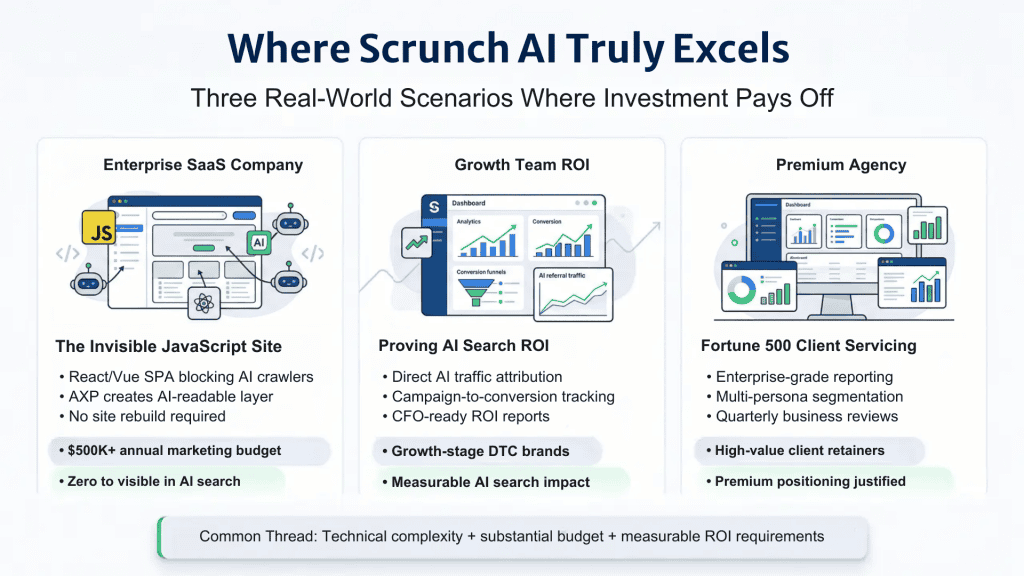
Use Case 1: The Enterprise SaaS Company with an Invisible Website
Situation: A B2B software company built their marketing site on a modern React SPA two years ago. It looks great, loads fast, and converts well. But their analytics team just noticed zero crawl activity from any AI bot. GPTBot can’t render the JavaScript, which means ChatGPT effectively can’t read their site.
Why Scrunch fits: A full site rebuild isn’t in the 2026 roadmap, and a static alternative site would require significant dev resources regardless. The AXP gives their engineering team a contained, manageable integration that creates a parallel AI-readable layer — without touching their production site. For a company with $500K+ annual marketing budget, the Enterprise plan cost is noise. The risk-reward calculus is different at this scale.
Use Case 2: The Growth Team Trying to Prove AI Search ROI
Situation: A fast-growing DTC brand needs to justify their AEO investment to the CFO. They know they’re getting traffic from AI referrals, but can’t attribute it to specific campaigns or tie it to conversions.
Why Scrunch fits: The GA4 integration is built for exactly this. The AI referral traffic dashboards make it possible to connect an AEO initiative directly to sessions, signups, or purchases. Combined with prompt-level tracking, a growth team can run controlled experiments — update a page, track the citation change over 30 days, measure referral traffic change — and build an ROI narrative that holds up in a budget review.
Use Case 3: The Agency with a Few High-Value Enterprise Clients
Situation: A 12-person digital agency has landed two Fortune 500 clients who need dedicated AEO reporting and are willing to pay for it. The team needs a platform that looks and performs at the enterprise level for quarterly business reviews.
Why Scrunch fits: The clean UI, persona-based segmentation, and GA4-powered reporting make for polished deliverables. The Agency plan includes pitch environments for prospecting. If the revenue per client justifies the $500/month platform cost, Scrunch can work. The key word there is if — this model breaks down quickly if you’re trying to spread that cost across 15 mid-market clients.
Final Verdict: Right Tool, Wrong Audience — For Most of Us
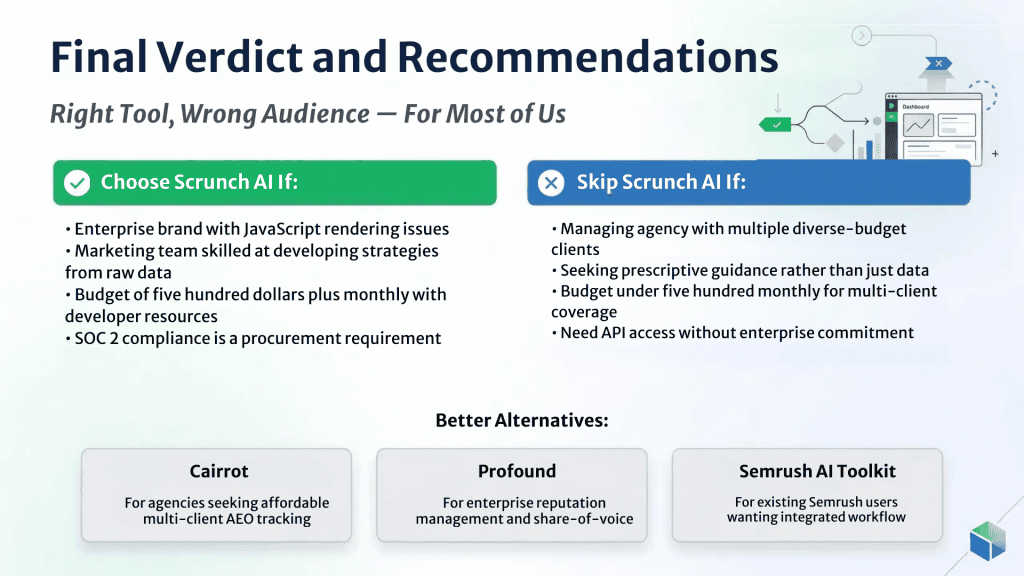
After weeks of testing and months of following this product’s development, my honest assessment of Scrunch AI is this: the engineering team built something genuinely innovative. The AXP is the kind of creative solution that makes a category more interesting. The GA4 integration is the best I’ve seen in this space. The Citation Intelligence data, when you know how to use it, is actionable in ways most AEO tools aren’t.
But the pricing, the per-brand billing structure, the developer requirements for the headline feature, and the absence of any content execution tools make this a hard sell for the majority of the market.
Buy Scrunch AI if:
- You’re an enterprise brand with a JavaScript rendering problem that’s blocking AI crawler access
- Your marketing team is comfortable building their own content strategy from raw data
- You have $500+/month to commit, plus developer bandwidth for AXP setup
- You need SOC 2 compliance for procurement reasons
Skip Scrunch AI if:
- You’re running an agency with multiple clients at varying price points
- You want the platform to tell you what to do, not just what’s happening
- Your budget is under $500/month and you need multi-client coverage
- You want API access without negotiating an enterprise contract
Consider these alternatives instead:
- Cairrot — Best for agencies needing affordable, multi-client AEO tracking with a free API and clear action reports. This is what I use daily.
- Profound — Best for enterprise brands prioritizing reputation management, share-of-voice benchmarking, and access to prompt volume data.
- Semrush AI Visibility Toolkit — Best if you’re already a Semrush customer and want AEO added to your existing workflow without a new vendor relationship.
The AI search landscape is moving fast, and no tool in this category has fully solved the “monitoring-to-action” gap yet. Scrunch is one of the more ambitious attempts, and for the right buyer, it earns its price. For everyone else, there are better fits at better prices, and the tools are only getting better.


